
Weekly Worship Attendance is Good for Your Mental Health

Since 2001, Gallop (a secular research group) has surveyed to understand mental health and how it has changed among different demographics each year. Do not miss these two things:
1. The ONLY group of people who said their mental health is excellent that grew in 2020 is that group of people who attend WEEKLY church services.
2. The demographic of people with the most reporting their mental is excellent is the same group of people who attend WEEKLy church services.
Among those who attended church services every week in 2020, 46% reported that their mental health is excellent. That's an increase of 4% in 2020. Of those who attend a couple of times per month or monthly, only 35% said their mental health is excellent, a 12% drop.
The most likely indicator of excellent mental health is not income, political party, race, or marital status. It's church attendance. But it's essential to realize that these demographics overlap. For example, 41% of males said their mental health was excellent, while only 27% of females reported excellent. 41% of married participants said their mental health was excellent compared to only 27% of the single people surveyed. Republicans reported 41%, while Democrats reported 29%. White reported 35% while non-white was 32%. Therefore, a married, Republican male who attends church weekly is more likely to be in excellent mental health than a single, Democrat female.
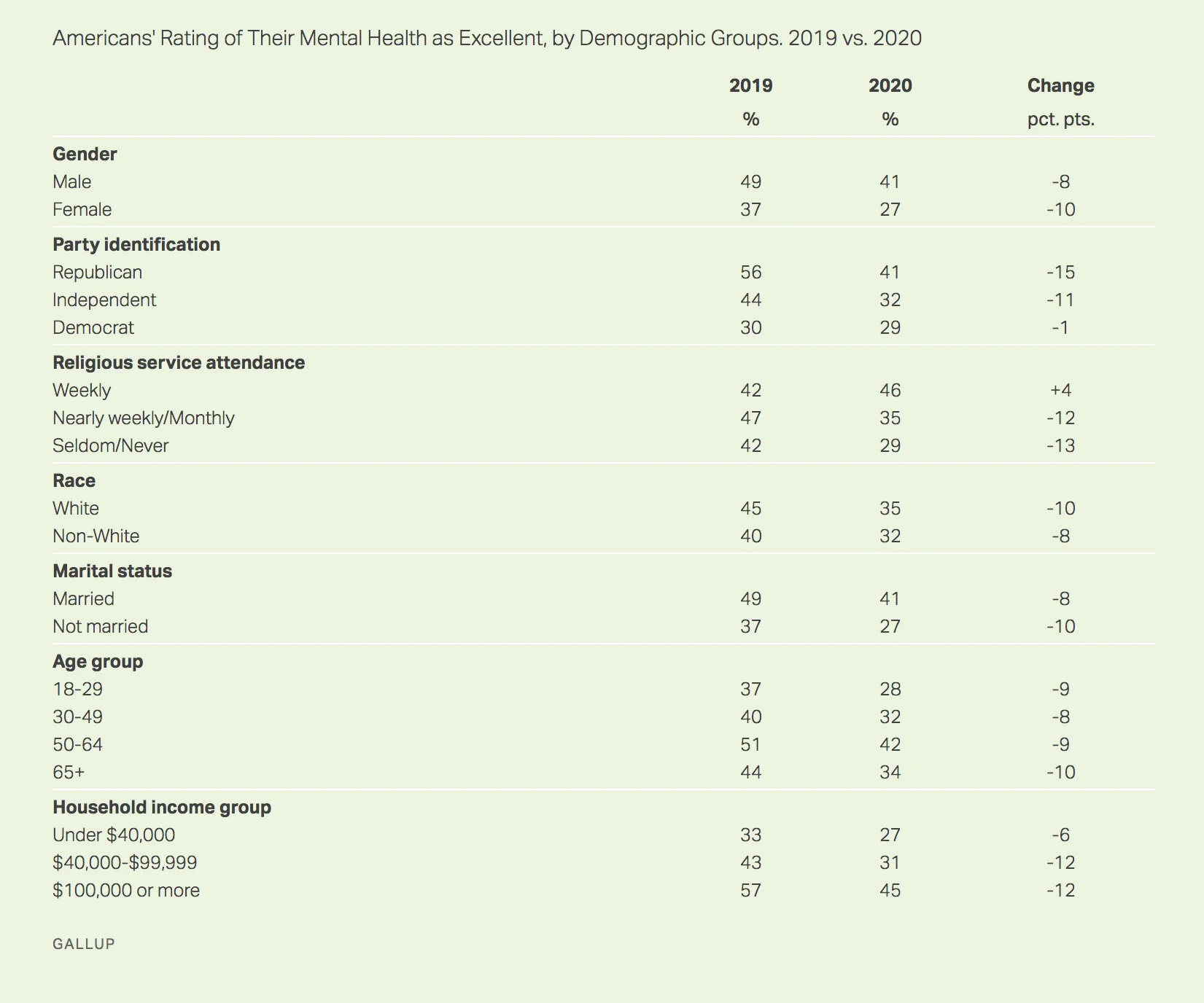
These measurements are not trying to identify all the categories you should try to fall in. Instead, they isolate different factors to see what impact those various factors might have upon mental health. There is also a factor of self-reporting, one of the weaknesses of surveys. Yet, when these surveys are conducted year after year, change (up or down) is measured. Regardless of the self-reporting weakness, the change over time is telling.
In the case of this study, nearly every demographic had a drop; most of them double-digit declines. One group had only a 1% drop, except it was already low, at the bottom of the political party's options. The top of that category took a 15% drop among the excellent mental health responses. (The survey was taken from November 5th to the 19th, which may have contaminated the self-reporting responses one way or the others.)
Church attendance, however, had two categories drop in the double-digits and one climb. That's interesting!
While nearly weekly or monthly attendance was once higher than weekly attendance, 2020 has brought severe changes. The nearly weekly response took a 12% hit. Weekly attendance saw 4% more people report they had excellent mental health in 2020 compared to 2019.
From this study, we should conclude that there is a benefit gained by weekly church service attendance. And looking at all those drops in other mental health factors, it's probably fair to say it's a precious benefit.
Read Gallop's report for yourself here.
I hope we see you at our weekly worship gathering. We meet on Sunday mornings at 11 AM.
Pastor Bryan